

Concrete work is often the point where everything must come together. The base needs to be right, the levels need to work, and once the truck arrives, there’s not much room for hesitation. With some straightforward planning, a bit of shared know-how and the right support on site, it is entirely possible to achieve the sort of finish you would expect from a small builder or groundwork team.
Start with a clear plan
Most issues do not come from the concrete itself, but from what happens beforehand. Rough measurements, uncertain levels and guessed quantities all make life harder than it needs to be.
It helps to:
- Measure the area accurately, including any steps or cut-outs.
- Decide the finished height relative to doors, damp proof course and surrounding ground.
- Think about where water should go and whether you need a gentle fall.
Once that is sketched out, conversations about thickness, strength and volume become much more straightforward. A quick chat with the New Mix team can flag anything that looks off before you commit to an order.


Groundwork that supports the slab
Concrete only performs properly if the ground beneath it does its job. Shallow dig-outs or soft patches might look fine on day one, but can lead to movement and cracking over time.
A good approach is to:
- Remove topsoil and organic material until you reach firm ground.
- Lay a suitable hardcore or MOT type 1sub base and compact it in layers.
- Check levels with a straightedge and spirit level rather than relying on eye alone.
Once you have done this a couple of times, the process becomes familiar, and the same principles scale from a modest shed base to larger patios and small extensions.

Formwork, access and New Mix on site
Formwork and access are where projects either run smoothly or become a scramble. Strong, well-fixed edge boards keep the slab to size and give you a solid reference for levels. At the same time, it is worth thinking carefully about how the concrete will actually reach the pour area from the truck.
This is where New Mix’s “We barrow it, so you don’t have to” approach comes in. Instead of leaving you to shift tonnes of wet concrete across the job, their team wheelbarrows it from the mixer to the pour point as part of the service. They work through side gates, up paths and around awkward corners, which means you can concentrate on setting levels and finishing rather than spending the day pushing barrows. It keeps the pace steady, reduces fatigue and is particularly useful on tight domestic sites where access for machinery is limited.
Pouring and finishing with confidence
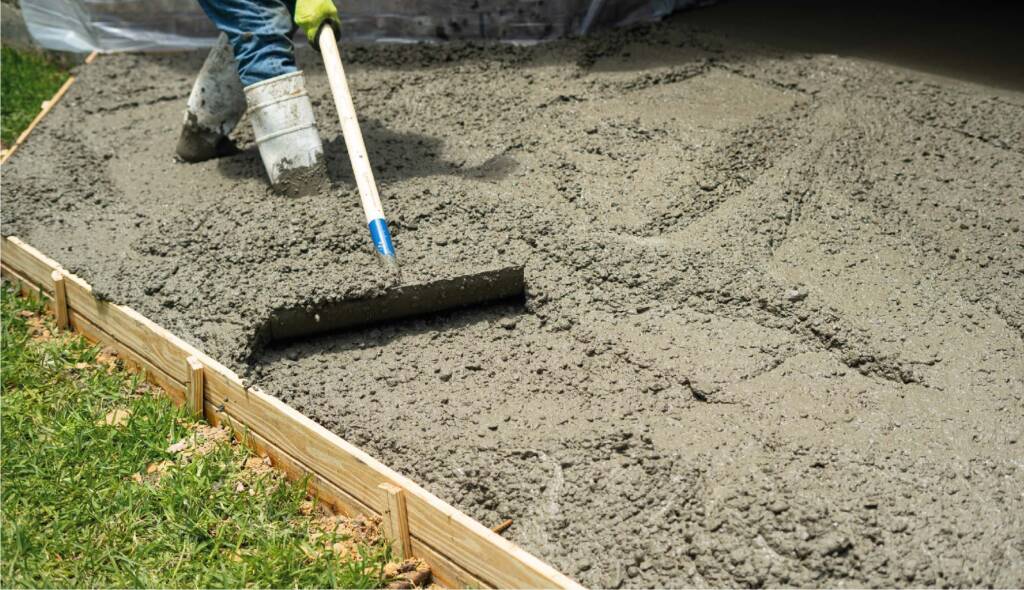
On the day, having roles agreed in advance makes a noticeable difference. With New Mix handling the barrow runs, you can assign people to spreading, tamping and checking levels as the concrete arrives. Tools such as shovels, rakes, a tamping beam or straightedge, and a float should be ready to go. Concrete can then be worked into corners and edges first, before being struck off to the formwork.
For most domestic slabs, a tamped or lightly brushed finish is practical and forgiving, especially in the UK climate. It provides grip when wet and does not require specialist equipment. The main thing is to avoid overworking the surface; once bleed water has risen and gone, a final light pass is usually enough.
Curing: protecting the work you have done
Curing is often treated as an afterthought, but it has a big influence on long‑term performance. Concrete benefits from being protected from rapid drying, frost and heavy loading in the early days.
Simple measures such as covering the slab, keeping it lightly damp or using a curing product can significantly reduce the risk of shrinkage cracks and surface dusting. It is a small investment of effort compared with the cost of putting a slab right later.
From a one‑off project to a trusted partner
Many of New Mix’s regular customers originally came for a single project: a workshop floor, a shed base, a driveway. After seeing how fresh, on-site mixed concrete, clear advice and the “We barrow it, so you don’t have to” service simplified the whole process, they have returned for future jobs.
If you are planning a slab and want it to meet trade standards, New Mix’s installation guides are a useful reference, covering preparation, placing, finishing, and curing. For help fine-tuning your plans, quantities and timings, you can call 0161 834 1312 or email sales@newmixconcrete.co.uk and talk it through with the team.